
Pocahontas facts for kids
Quick facts for kids
Pocahontas
|
|
|---|---|
.png)
Pocahontas depicted in a 1616 portrait engraving by Simon de Passe
|
|
| Born |
Amonute
c. 1596 |
| Died | March 1617 (aged 20–21) |
| Resting place | St George's Church, Gravesend, England |
| Other names | Matoaka, Rebecca Rolfe |
| Known for | Association with Jamestown colony, Powhatan peacemaker, traveler to England |
| Spouse(s) | |
| Children | Thomas Rolfe |
| Parent(s) | Wahunsenacawh (father) |
Pocahontas (born Amonute, also known as Matoaka; c. 1596 – March 1617) was a famous Native American woman from the Powhatan people. She is remembered for her role in American colonial history and her connection to the English settlement at Jamestown, Virginia. Her father was Wahunsenacawh, the supreme ruler of many allied tribes in a large coastal region called Tsenacommacah.
During a time of conflict between her people and the English settlers, Pocahontas helped maintain communication between both cultures. She was later taken into English custody in 1613 during trade disputes. While living among the colonists, she studied the English language and culture, embraced Christianity, and took the baptismal name Rebecca.
In 1614, she married an English tobacco farmer named John Rolfe, which helped bring several years of peace between the colonists and the Powhatan nation. Pocahontas traveled with her husband and young son to London, England, in 1616. She met high-ranking English leaders and attended royal gatherings before falling ill and passing away in 1617 at a young age.
Contents
Early Life and Powhatan Culture
Who Was Pocahontas?
Pocahontas was born around the year 1596 in the coastal lands of what is today Virginia. Her birth name was Amonute, but she carried other names throughout her life. Her people belonged to the Algonquian language family and lived in settled agricultural communities.
Her father was the paramount chief Wahunsenacawh, commonly known to the English settlers as Chief Powhatan. He led an alliance called the Powhatan Confederacy, which united around thirty different tribes. These tribes lived throughout the eastern waterways and forests of Virginia.
Historians know very little about her mother. Powhatan customs recorded by early English visitors suggest that chiefs had multiple wives from different villages. Mattaponi oral histories tell that Pocahontas was named after her mother, who was deeply loved by Chief Powhatan.
Traditional Names and Meanings
Names held great personal and spiritual meaning among the Powhatan people. Children often received a formal name at birth and an informal name among family. Some individuals also carried names meant to protect them from harm.
The name Amonute was likely her original birth name. She was also called Matoaka, a private name that carried deep cultural importance. The name "Pocahontas" was actually a playful childhood nickname meaning "playful one" or "mischievous child."
English writers noticed that she was very active, energetic, and curious about the world. When she was baptized into the Christian faith years later, she took the biblical name Rebecca. This name was chosen partly because Rebecca in the Bible was seen as a mother of two distinct peoples.
Was Pocahontas a Real Princess?
In popular books and modern movies, Pocahontas is frequently described as an "Indian princess." European settlers used words like "emperor," "king," and "princess" to describe Native leaders because that was how European governments worked.
In Powhatan society, leadership did not automatically pass from a father to his children. Instead, power was passed down through the female line to brothers, sisters, and their children. Because of this matrilineal system, Pocahontas was not an heir to her father's political rule.
Even though she was not an heir to the leadership, she was a favored child of a powerful leader. English colonists treated her with great respect because of her father's high status in the region.
Encounters with the English at Jamestown
The Arrival of the English Settlers
In the spring of 1607, three English ships landed on the shores of Virginia to establish Jamestown. It was the first permanent English settlement in North America. The settlers faced extreme challenges, including unfamiliar diseases, bad water, and food shortages.
The English settlement was built right inside the territory of the Powhatan Confederacy. This led to complicated relations between the two groups. Sometimes they traded food and tools peacefully, while at other times they engaged in armed skirmishes.
Pocahontas was around ten or eleven years old when the settlers arrived. She was naturally curious about the newcomers, their strange metal tools, large wooden ships, and new customs.
The Famous Legend of Captain John Smith

The most famous story involving Pocahontas is her supposed rescue of Captain John Smith. In December 1607, Smith was captured by Powhatan warriors while exploring the Chickahominy River. He was brought to the chief's village at Werowocomoco.
According to a book published by Smith in 1624, he was placed between two large stones and threatened with wooden clubs. Smith wrote that Pocahontas suddenly rushed forward, placed her head over his, and convinced her father to spare his life.
Historians debate whether this rescue happened exactly as Smith described. Smith did not mention the dramatic rescue in his earliest writings from 1608. He only wrote about it in detail years later after Pocahontas became famous in England.
Many modern historians believe the event was a planned adoption ritual rather than a real execution. In this ritual, Smith was symbolically "saved" so he could be reborn as an honorary member of the Powhatan tribe. Chief Powhatan wanted to bring the English under his leadership and control their trade goods.
Building Bridges and Helping the Settlers
Regardless of what happened during Smith's capture, Pocahontas became an important friend to the Jamestown colony. She frequently visited the fort with Powhatan messengers, carrying gifts of corn, meat, and grain to the starving settlers.
English records state that her deliveries of food kept many colonists alive during the harsh winter of 1608. She was well liked by the colonists and often played games with the young boys inside the fort.
Her friendship helped maintain fragile moments of peace between two very different societies. However, as the English colony expanded and took more Native land, relations grew hostile once again. In late 1609, John Smith was badly injured by a gunpowder accident and returned to England, and the colonists told Pocahontas that he had died.
Captivity and Life at Henricus
The First Anglo-Powhatan War
By 1610, tensions between the Powhatan people and the Jamestown settlers erupted into open warfare known as the First Anglo-Powhatan War. Both sides raided villages, destroyed crops, and took prisoners.
Because of the fighting, Pocahontas stopped visiting Jamestown. She spent time living with allied tribes, including the Patawomeck people along the Potomac River. The war caused terrible hardships for both Native villagers and English settlers.
Capture and Negotiations

In the spring of 1613, an English captain named Samuel Argall learned that Pocahontas was staying near the Potomac River. Argall decided to take her captive to use her as a bargaining tool against her father.
Argall convinced the local Patawomeck leader, Iopassus, to help lure Pocahontas onto an English trading ship. Once aboard, she was not allowed to leave. The English demanded that Chief Powhatan return English prisoners, stolen weapons, and tools in exchange for his daughter.
Chief Powhatan sent back some prisoners and broken guns, but refused to meet all the English demands. As a result, Pocahontas remained with the colonists for over a year while negotiations stalled.
Conversion and Christian Baptism
During her captivity, Pocahontas lived at the settlement of Henricus, located upriver from Jamestown. She was placed under the care of an English minister named Alexander Whitaker.
Whitaker taught Pocahontas about the English language, European customs, and the Christian religion. She learned quickly and adapted to life among the settlers. In early 1614, she made the personal decision to convert to Christianity and was officially baptized, taking the name Rebecca.
Marriage and the "Peace of Pocahontas"
Meeting John Rolfe

While living at Henricus, Pocahontas met John Rolfe, a successful English farmer who had introduced a sweet variety of tobacco to Virginia. Rolfe was a widower who had lost his first wife and child on their journey to the colony.
Rolfe developed deep romantic feelings for Pocahontas. Before he could marry her, he had to ask for formal permission from the colonial governor, Sir Thomas Dale. In a famous letter, Rolfe explained his sincere love for Pocahontas and his desire to build a peaceful relationship between their communities.
Chief Powhatan also gave his consent to the marriage. He sent his brother and two sons to attend the wedding ceremony as official representatives of the Powhatan Confederacy.
A Royal Wedding and Lasting Peace
Pocahontas and John Rolfe were married on April 5, 1614, in the church at Jamestown. The wedding was a major historical milestone. It was one of the earliest recorded marriages between an English colonist and a Native American woman.
The union brought an immediate end to the First Anglo-Powhatan War. It created a friendly alliance known as the "Peace of Pocahontas," which allowed trade and farming to flourish without violence for eight years.
The couple lived on Rolfe's plantation, called Varina Farms, across the river from Henricus. In January 1615, Pocahontas gave birth to their son, Thomas Rolfe.
Journey to England
The London Company's Mission

The London Company, the business group funding the Jamestown colony, wanted to encourage more people to invest in Virginia. The leaders of the company saw Pocahontas as living proof that Native Americans could learn English ways and adopt Christianity.
In the spring of 1616, the Rolfe family boarded a ship for England. They were accompanied by around a dozen other Powhatan men and women, including a respected advisor named Tomocomo.
The ship landed in the English port of Plymouth on June 12, 1616. From there, the group traveled by horse-drawn coach to London, where Pocahontas was introduced to high society.
Life in London Society
In England, Pocahontas was treated like an important foreign visitor. She attended social parties, banquets, and theatrical shows called masques. She was presented to King James I and Queen Anne of Denmark at the Palace of Whitehall.
An engraving of her was made by the artist Simon de Passe in 1616. In this famous portrait, she is dressed in elegant Jacobean clothing, wearing a high-collared lace dress and holding a feather fan. The Latin inscription on the portrait honored her as the daughter of a powerful ruler.
During her time in England, she also reunited with Captain John Smith. When they met, she was surprised and emotional because she had long believed he was dead. She reminded him of the friendship he shared with her father and insisted on calling him "father," as was the custom between respected allies.
Illness, Death, and Burial

In March 1617, Pocahontas and her family prepared to return home to Virginia. They boarded a ship sailing down the River Thames, but she became critically ill before they reached the open ocean.
She was taken ashore at the town of Gravesend in Kent. Despite medical care, she passed away on or around March 21, 1617, at the age of 20 or 21. The exact cause of her illness is unknown, but historians suggest it may have been pneumonia, smallpox, or tuberculosis.
Pocahontas was buried in the chancel of St George's Church, Gravesend. A terrible fire destroyed the original church in 1727, so the exact location of her grave was lost over time. Today, a life-sized bronze statue stands in the churchyard to honor her memory.
Her husband, John Rolfe, returned to Virginia to manage his tobacco plantations. Their young son, Thomas Rolfe, was left in England to be raised and educated by his uncle before returning to Virginia as an adult.
Historical Impact and Legacy
Descendants and the First Families of Virginia
Thomas Rolfe grew up to become a prominent landowner in Virginia. He married Jane Poythress, and they had a daughter named Jane Rolfe. Jane married Robert Bolling, establishing a prominent family line with many descendants.
Many well-known American figures trace their family trees back to Pocahontas and John Rolfe. These descendants include First Lady Edith Wilson, astronomer Percival Lowell, and modern actor Edward Norton.
In Virginia history, descendants of Pocahontas were proudly referred to as members of the First Families of Virginia.
Honors and Memorials
Pocahontas remains one of the most recognized Native American historical figures. Over the centuries, her life has been honored with monuments, geographical names, and artistic works across the globe:
- In 1907, she became the first Native American woman to appear on a United States postage stamp.
- Towns in Virginia, Iowa, and Arkansas were named in her honor.
- A crater on Venus and an asteroid in space (4487 Pocahontas) bear her name.
- In 2015, her ancestral community, the Pamunkey tribe, gained official federal recognition in Virginia.
Image Gallery
-
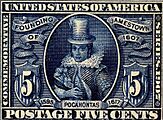
Pocahontas commemorative postage stamp of 1907
-
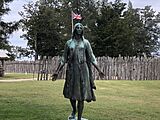
Statue in Jamestown, Virginia
-
Likeness of Pocahontas on the seal of Henrico County, Virginia
-
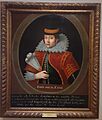
A painting of Pocahontas in the National Portrait Gallery in Washington, DC


Pocahontas in Popular Culture

Theater and Music
For hundreds of years, Pocahontas has been a favorite subject of plays, poems, and musical theater. Early nineteenth-century writers often changed historical facts to make her story more dramatic.
- The Indian Princess (1808) was one of the earliest American plays to portray her life.
- Po-ca-hon-tas, or The Gentle Savage (1855) was a popular comedic musical in London and New York.
- In 1939, composer Elliott Carter created a famous classical ballet based on her life.
Animated and Live-Action Films
Pocahontas has been featured in several major motion pictures. The most famous depiction is the 1995 animated film Pocahontas by The Walt Disney Company.
- The animated film portrayed her as a young adult who loved nature and fell in love with John Smith.
- A direct-to-video sequel, Pocahontas II: Journey to a New World (1998), showed her journey to London and marriage to John Rolfe.
- The 2005 live-action movie The New World, directed by Terrence Malick, presented a detailed look at the founding of Jamestown.
Historians and Native American scholars note that animated movies often invent romantic storylines and change timelines. In real history, Pocahontas was just a child when she met John Smith, and their relationship was based on political communication and friendship rather than romance.
See also
 In Spanish: Pocahontas para niños
- Jamestown, Virginia – The first permanent English colony in North America
- Powhatan people – The Native American confederacy led by Chief Wahunsenacawh
- John Smith – English soldier, explorer, and author
- John Rolfe – English colonist and husband of Pocahontas
- Pamunkey – Native American tribe descended from the Powhatan alliance
